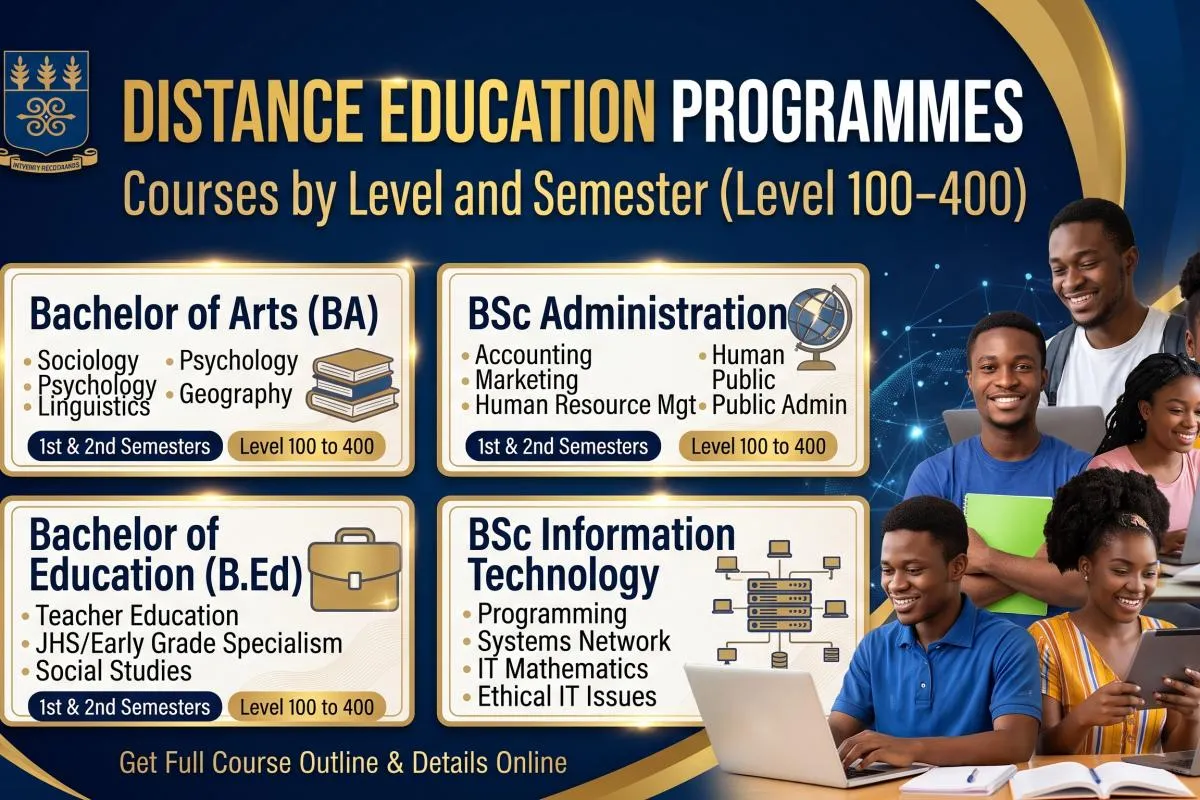
The University of Ghana Distance Education course list for 2025/2026: Level 100–400 courses for BA, BA Bouquets, BSc Administration, B.Ed and BSc IT in both semesters, plus the UGRCs, HERCs and registration rules you must follow.

The University of Ghana Department of Distance Education (School of Continuing and Distance Education, College of Education) has published its course bulletins for the 2025/2026 academic year, one for the first semester and a revised one for the second semester. This guide puts both bulletins in one place so you can quickly see which courses to register for at your level, which University Required Courses (UGRCs) and Humanity and Education Required Courses (HERCs) you must add, and the rules that trip students up every year.
It covers the Bachelor of Arts (BA), the BA Bouquets (Administration with courses in Social Science), BSc Administration (University of Ghana Business School options), the Bachelor of Education specialisms and the BSc Information Technology, from Level 100 to Level 400.
Quick answers: UG Distance Education course registration 2025/2026
- Level 100 BA students take the three subjects assigned to their group (BA 1 to BA 6), one HERC and the University Required Course for the semester: UGRC 150 (Critical Thinking and Practical Reasoning) in the first semester and UGRC 110 (Academic Writing I) in the second semester. That is 15 to 18 credits.
- Choose your HERC from a different department from your main subjects (for example PODE or ECON), in both semesters.
- Pass every University Required Course with a grade D or better. Students who fail to sit the UGRC examinations will not graduate.
- Do not duplicate research courses across your two departments; most departments tell you to replace their research course with an elective if you already take research elsewhere.
- Diploma-to-degree students add UGRCs on top of their main courses. If that takes you above the 21-credit maximum, email the College Academic Officer at coeacademic@ug.edu.gh.
- For course-selection help, visit your Learning Centre or the Student Support Unit (DE Office) on Main Campus.
Level 100 BA: assigned subject groups (BA 1 to BA 6)
Every Level 100 BA student is placed in a group with three assigned subjects. The first-semester and second-semester courses for each subject are:
 Free CV Builder
Build a job-winning CV in minutes: 12 templates, cover letter, PDF & Word. Free to start.
Build my CV
Advertise here
| Subject | First semester | Second semester |
|---|---|---|
| Economics | ECON 101 Introduction to Economics I | ECON 102 Introduction to Economics II |
| Human Resource Development | HRDE 101 Introduction to Human Resource Development | HRDE 102 Adult Education and HRD |
| Information Studies | INFS 111 Information in Society | INFS 112 Introduction to Information Management |
| Professional Development | PODE 101 Introduction to Professional Development | PODE 102 Foundations of Human Development |
| Political Science | POLI 111 Introduction to the Study of Political Science | POLI 112 Introduction to Ghanaian Politics |
| Psychology | PSYC 101 Elements of Psychology | PSYC 102 Psychology for Everyday Living |
| Sociology | SOCI 121 Principles of Social Organization | SOCI 122 Diversity of Peoples and Cultures |
| French (BA 5) | FREN 101 Oral Skills and French and Francophone Studies I; FREN 103 Basic French Grammar | FREN 102 and FREN 104 |
The bulletin lists each group (BA 1 to BA 6) with its assigned subjects in one column and its HERC options in the next. Your group and your three subjects are on your admission and registration record, so always register the subjects assigned to you, not the ones you prefer. French (FREN 101/103 and FREN 102/104) is offered in BA 5, and Human Resource Development (HRDE) in BA 6.
HERCs (Humanity and Education Required Courses) for Level 100
| First semester options | Second semester options |
|---|---|
| TEES 101 Foundations of Education; PESS 101 Sports in the Making of the Modern World I; UGBS 101 Introduction to Business Administration; UGBS 105 Introduction to Public Administration; or another Level 100 subject outside your group | TEJS 102 Social, Cultural and Psychological Basis of Learning; PESS 102 Sport in the Making of the Modern World II; UGBS 102 Introduction to Computing in Business; UGBS 104 Principles of Management; EDTE 102 (re-sit only) |
University Required Courses (UGRCs) by level
| Who | First semester | Second semester |
|---|---|---|
| Level 100 (all programmes) | UGRC 150 Critical Thinking and Practical Reasoning | UGRC 110 Academic Writing I |
| Level 200 continuing students | UGRC 210 Academic Writing II | One of UGRC 228 Chieftaincy and Development, UGRC 229 Culture and Development, UGRC 231 Gender and Development |
| Level 200 diploma-to-degree | UGRC 110 Academic Writing I and UGRC 150 | UGRC 210 Academic Writing II plus one of UGRC 228/229/231 |
| Admitted at Level 300 (diploma-to-degree) | UGRC 150 | UGRC 110 Academic Writing I |
| Level 400 students admitted at Level 300 | UGRC 210 Academic Writing II | One of UGRC 228/229/231 (if not yet taken) |
BSc Information Technology students take CBAS 210 Academic Writing II in place of UGRC 210. Under the new system (2020/2021 onward), BA and BSc Administration students must complete UGRC 110, UGRC 150, a HERC at Level 100, UGRC 210 and one of UGRC 228–231 before graduating.
BA departments: Level 200 to Level 400 courses
Psychology
| Level | First semester | Second semester |
|---|---|---|
| 200 | PSYC 221 Introduction to General Psychology; PSYC 223 Biological Psychology | PSYC 222 Motivation and Emotion; PSYC 224 Introduction to Experimental Psychology |
| 300 | Core: PSYC 331 Statistics for Psychologists, PSYC 333 Psychology of Personality, PSYC 335 Developmental Psychology I. Elective: PSYC 337 Psychology of Learning | Core: PSYC 332 Cognitive Psychology I, PSYC 334 Research Methods in Psychology. Electives: PSYC 336, PSYC 338 Abnormal Behaviour, PSYC 342 Psychological Tests and Measurements |
| 400 | Core: PSYC 441 Cognitive Psychology II, PSYC 443 Social Psychology, PSYC 449 Practicals in Cognition II. Electives: PSYC 445 Clinical, PSYC 447 Educational, PSYC 457 Industrial Psychology | Core: PSYC 444 Psychology and National Development. Electives (two): PSYC 448, 452, 454, 456 |
Rules: Level 300 combined majors take PSYC 331 plus one other core and PSYC 337 (9 credits), and should not take a research course in another department. Satisfy all prerequisites. Revising PSYC 221 or PSYC 223 this semester? Use the free session-by-session PSYC 221 prep tests and PSYC 223 prep tests, built from the official slides, with every answer explained.
Sociology
| Level | First semester | Second semester |
|---|---|---|
| 200 | SOCI 221 Basic Concepts in Sociology; SOCI 223 Traditional Ghanaian Social Institutions | SOCI 222 Comparative Social Institutions; SOCI 224 Social Structure of Modern Ghana |
| 300 | Core: SOCI 321 Foundations of Social Thought, SOCI 323 Social Psychology, SOCI 325 Research Methods. Electives: SOCI 337 Rural, SOCI 339 Urban Sociology | Core: SOCI 322 Perspectives in Social Theory, SOCI 324 Groups, Organization and the Individual, SOCI 326 Quantitative Methods in Social Research. Electives: SOCI 338, 340, 344, 346 |
| 400 | Core: SOCI 421 Social Anthropology, SOCI 423 Theories of Social Development, SOCI 425 Industrial Sociology I. Electives: SOCI 439, 441, 443, 447 | Core: SOCI 422 Societies and Cultures of Africa, SOCI 424 Context of Development and Underdevelopment, SOCI 426 Industrial Sociology II. Electives: SOCI 442, 444, 448 |
Watch the prerequisites: SOCI 321, 323 and 325 are prerequisites for SOCI 322, 324 and 326, and the bulletin says this rule is strictly enforced. Sociology majors do not write a long essay unless approved through the Head of Distance Education.
Political Science
| Level | First semester | Second semester |
|---|---|---|
| 200 | POLI 211 Introduction to Development Studies; POLI 213 Introduction to Public Administration | POLI 212 Introduction to International Politics; POLI 214 Introduction to Comparative Politics |
| 300 | Core: POLI 341 Ancient and Medieval Political Thought, POLI 343 Introduction to Political Research. Electives: POLI 347, 353, 357, 359 | Core: POLI 342 Modern Western Political Thought, POLI 344 Methods of Political Research. Electives: POLI 346, 358, 362, 364 |
| 400 | Core: POLI 441 Political Economy of Africa's Development, POLI 443 Applied Political Research. Electives: POLI 445, 447, 453, 457, 467, 469 | Core: POLI 442 Social and Political Theory, POLI 444 Electoral Politics and Democracy in Ghana. Electives: POLI 446, 448, 452, 454 |
There is no single major in Political Science: combined majors take two cores and one elective each semester.
Information Studies
| Level | First semester | Second semester |
|---|---|---|
| 200 | INFS 211 Introduction to Information Technology; INFS 213 Information Management | INFS 212 Principles of Management; INFS 214 Introduction to Computing |
| 300 | Core: INFS 321 Information Sources, INFS 323 Research Methods, INFS 325 Public Relations. Electives: INFS 327, 329 Database Management, 331 Records Management | Core: INFS 322 Classification, INFS 324 Indexing and Abstracting, INFS 328 System Analysis and Design. Electives: INFS 326, 332 |
| 400 | INFS 420 Long Essay (6 credits, with consent), INFS 421 Automation of Information Systems, INFS 423 Preservation of Information Resources. Electives: INFS 427, 429, 431 | INFS 422 Information Storage and Retrieval, INFS 424 Marketing of Information Services. Electives: INFS 426, 428, 432 |
Economics
| Level | First semester | Second semester |
|---|---|---|
| 200 | ECON 211 Elements of Economics I; ECON 213 Elements of Mathematics for Economists; ECON 215 Introduction to Economy of Ghana I | ECON 212 Elements of Economics II; ECON 214 Elements of Statistics for Economists; ECON 216 Introduction to Economy of Ghana II |
| 300 | Core: ECON 311 Microeconomic Theory I, ECON 313 Macroeconomic Theory I. Electives: ECON 315, 317 | Core: ECON 312, ECON 314. Electives: ECON 316, 318 |
| 400 | Core: ECON 441 Economic Theory I. Electives: ECON 453 Public Finance I, 473 Money and Banking I, 469 Labour Economics I | Core: ECON 442 Economic Theory II. Electives: ECON 454, 472, 474 |
Adult Education, Human Resource Development and Professional Development
- Level 200 Professional Development: PODE 201 Essential Soft Skills, PODE 203 Adult Education for Professionals (first semester); PODE 202 Contemporary Issues in Professional Development, PODE 204 Adult Psychology (second semester).
- Level 200 Human Resource Development: HRDE 201 and HRDE 203 (first semester); HRDE 202 Inclusive Education and HRD, HRDE 204 Adult Psychology (second semester).
- Level 300 Adult Education: ADLT 301 Research Methods, ADLT 303, ADLT 305, elective ADLT 319 (first); ADLT 302 Data Organisation and Analysis, ADLT 304, ADLT 306, electives ADLT 308 and 326 (second).
- Level 400 Adult Education: ADLT 401, 403, 409 (first); ADLT 402, 404 and elective ADLT 406 (second).
French
Level 200: FREN 211, 213, 215 in the first semester and FREN 212 Introduction to Translation, FREN 214 and FREN 216 in the second semester.
BA Bouquets: Administration with courses in Social Science
The BA Bouquets combine a UGBS option (Accounting, Human Resource Management or Public Administration) with a Social Science subject (Psychology, Professional Development, Sociology, Information Studies or Adult Education).
| Level | First semester (all bouquets) | Second semester (all bouquets) |
|---|---|---|
| 100 | UGBS 101 Introduction to Business Administration, UGBS 105 Introduction to Public Administration + two Social Science subjects (e.g. PSYC 101, PODE 101, SOCI 121, INFS 111) + UGRC 150 + one HERC = 18 credits | UGBS 102 Introduction to Computing in Business, UGBS 104 Principles of Management + PSYC 102/PODE 102/SOCI 122/INFS 112 + UGRC 110 + one HERC |
| 200 | UGBS 201 Microeconomics and Business, UGBS 203 Commercial Law I, UGBS 205 Fundamentals of Accounting Methods + the two Level 200 courses of your Social Science subject + UGRC 210 | UGBS 202 Business Mathematics or UGBS 204 Macroeconomics and Business, UGBS 206 Commercial Law II, UGBS 208 Introduction to Financial Accounting + two subject courses + one of UGRC 228–231 |
| 300 | UGBS 301 Quantitative Methods or UGBS 303 Computer Applications in Management, plus option courses (ACCT 305/307, OHRM 303/305 or PADM 301/307) and three subject courses | Accounting: ACCT 304, 306, 308, 312. HRM: UGBS 302, OHRM 304, OMIS 302. Public Administration: UGBS 302, PADM 308, PADM 318. Plus three subject courses |
| 400 | Accounting: ACCT 401, 403, 405. HRM: UGBS 401, OHRM 404, FINC 407. Public Administration: PADM 401, 427, 413. Plus three subject courses | UGBS 402 Business Policy + option courses (ACCT 402/404, OHRM 402 and PADM 408, or PADM 408/414) + subject courses |
Note for Accounting and Psychology at Level 300: students reading UGBS 303 take PSYC 331 Statistics for Psychologists, while those reading UGBS 301 take PSYC 333 Psychology of Personality.
BSc Administration (UG Business School options)
Level 100: UGBS 101, UGBS 103 Introductory French I and UGBS 105, plus UGRC 150 and one HERC (first semester); UGBS 102 Introduction to Computing in Business, UGBS 104 Principles of Management, UGBS 106 Introductory French II and UGBS 108 Psychology for Everyday Living, plus UGRC 110 and one HERC (second semester).
Level 200: UGBS 201, 203, 205, 207 Social Responsibility and Ethics, UGRC 210 (first); UGBS 202, 204, 206, 208 and one of UGRC 228–231 (second).
Levels 300 and 400 by option:
- Accounting: UGBS 301, UGBS 303, ACCT 305, ACCT 307, OHRM 303 (L300 first); UGBS 302, ACCT 304, 306, 308, 312 (L300 second); UGBS 401, ACCT 401, 403, 405, FINC 401 (L400 first); UGBS 402, ACCT 402, 404, 406, FINC 402 (L400 second).
- Banking and Finance: FINC 301, MKTG 301, OHRM 303 with UGBS 301/303 (L300 first); FINC 302 Business Finance, FINC 304 Managerial Economics, MKTG 306, OHRM 304 (L300 second); FINC 401, 403, 405, 407 (L400 first); FINC 402, 404, 406, 408 (L400 second).
- Human Resource Management: OHRM 303, OHRM 305 Labour Law, FINC 301, MKTG 301 (L300 first); OHRM 304, OMIS 302, MKTG 306, FINC 302, FINC 304 (L300 second); FINC 407, OHRM 404 Manpower Planning plus electives (L400 first); OHRM 402 Industrial Relations, PADM 408 plus three electives (L400 second).
- Marketing: MKTG 301, 303, 305 Consumer Behaviour (L300 first); MKTG 302 Sales Management, 304, 306, 308 Retail Strategy (L300 second); MKTG 401 Marketing Research, 403, 405, 407 (L400 first); MKTG 402, 404, 406 Services Marketing (L400 second).
- Public Administration: PADM 301, 305, 307 (L300 first); PADM 304 Local Government Administration, 308, 312, 318 (L300 second); PADM 401, 409, 411, 413, 427 (L400 first); PADM 408, 414, 416, 418 (L400 second).
- Health Services Administration: HSMA 301 Digital Health and Innovations, 303, 307 (L300 first); HSMA 302, 304, 306, 312 (L300 second); HSMA 401, 403, 405, 407, 409 (L400 first); HSMA 402, 404 Applications of Epidemiology, 406 Health Law, 408 (L400 second).
Long essays (ACCT 400, OHRM 400, MKTG 400, PADM 400, HSMA 400) need departmental approval from the DE Head and start in the first semester. OHRM students writing a long essay take two electives; those not writing one take three.
Bachelor of Education (Early Grade, Upper Primary and JHS specialisms)
All three B.Ed specialisms share a Level 100 core: Foundations of Education in Ghana, Inclusive School-Based Inquiry, Introduction to Language and Literacy, Number and Algebra, Social Studies and TVET, TSTS 101 STS: Beginning Teaching I and UGTE 101 Introduction to Integrated Science I (21 credits). In the second semester they take the Social, Cultural and Psychological Basis of Learning, UGTE 102 ICT, UGTE 104 Communication Skills, Geometry and Handling Data, Integrated Science II, UGTE 106 and TSTS 102.
From Level 200, JHS students take the core plus a specialist track: ICT, English, Integrated Science, Mathematics or Social Studies (18 credits per semester). The Supported Teaching in Schools courses (TSTS 201/202 and 301/302) carry 6 to 9 credits, so plan your load around them.
BSc Information Technology (Department of Computer Science)
| Level | First semester | Second semester |
|---|---|---|
| 100 | UGRC 150, DCIT 101 Introduction to Computer Science, DCIT 103 Office Productivity Tools, DCIT 105 Mathematics for IT Professionals, STAT 111, ECON 101 (18 credits) | DCIT 102 Computer Hardware Fundamentals and Circuits, DCIT 104 Programming Fundamentals, MATH 122 Calculus I, UGRC 110, electives UGBS 104 / ECON 102 / STAT 112 |
| 200 | DCIT 201 Programming I, 203 Digital and Logic Systems Design, 207 Computer Organization and Architecture, 209 E-Business Architectures, 211 Database Fundamentals, CBAS 210 | DCIT 200 Internship, 202 Mobile Application Development, 204 Data Structures and Algorithms I, 208 Software Engineering, 214 Information Modelling; elective DCIT 212 |
| 300 | DCIT 301 Operating Systems, 303 Computer Networks, 313 Introduction to AI, 317 IT Project Management, 323 Multimedia and Web Design, 307 Mini-Project, 321 Software Evolution | DCIT 302 Human Computer Interaction, 304 Research Methods, 308 Data Structures and Algorithms II, 312 Information Security Management, 318 Programming II; electives DCIT 306 Cloud Computing, 322 |
| 400 | DCIT 401, 409 Digital Forensics and Cyber Security, 415 Advanced Software Engineering, 419 Agile Methods, 421 Persuasive Systems Development (DCIT 400 Project is registered in semester 2) | DCIT 400 Project, 402, 418 Systems and Network Security, 428 Wireless Systems and Networks; electives DCIT 404, 406, 412, 414, 416, 422, 426 |
Common registration mistakes to avoid
- Registering a HERC from your own department. The bulletin is explicit: pick it from a different department.
- Taking two research methods courses. Psychology, Sociology, Political Science, Information Studies and Adult Education all warn against duplicating research courses; duplicated courses count only once.
- Skipping a first-semester prerequisite. In Sociology, for example, SOCI 321/323/325 must come before SOCI 322/324/326.
- Forgetting UGRCs as a diploma-to-degree student. Add them, and email coeacademic@ug.edu.gh if they push you above 21 credits.
- Missing a UGRC exam. You must pass UGRCs with a D or better, and missing the exam means you cannot graduate.
Registration windows and exam dates are in our University of Ghana academic calendar guide. Once you are registered, sharpen your exam technique with 10 test-taking strategies for students and save money with these free textbook and academic resources.
Revise smarter with free course prep tests
The Isaac Mintah Academy offers free, exam-style prep tests for Distance Education courses, written from the official lecture slides. Each one has multiple-choice, true-or-false and fill-in-the-blank questions, a timer, and an explanation with the exact slide page for every answer. Current courses include PSYC 221 Introduction to General Psychology and PSYC 223 Biological Psychology, with more courses being added each semester.
Building your career while you study? Join the Professional Branding for Students session, or book one-on-one professional mentorship to plan your next step.
Frequently asked questions
How many credits should a UG Distance Education Level 100 student register?
Between 15 and 18 credits: three assigned subjects (9 credits), one HERC (3 credits) and the semester's UGRC (3 credits). B.Ed students take 21 credits.
Which UGRC do Level 100 students take in each semester?
UGRC 150 Critical Thinking and Practical Reasoning in the first semester and UGRC 110 Academic Writing I in the second semester.
What is a HERC?
A Humanity and Education Required Course, such as TEES 101, PESS 101/102, TEJS 102 or a Level 100 UGBS course. Level 100 BA and BSc Administration students take one each semester, chosen from a department other than their own subjects.
What is the maximum number of credits per semester?
21 credits. Diploma-to-degree students who would exceed it after adding UGRCs should email coeacademic@ug.edu.gh.
Can I write a long essay at Level 400?
Yes, in Information Studies, Accounting, HRM, Marketing, Public Administration and Health Services, but only with departmental approval from the Head of Distance Education, and it starts in the first semester. Sociology majors do not write a long essay unless specially approved.
This guide summarises the official UG Department of Distance Education first-semester and revised second-semester course bulletins for the 2025/2026 academic year. Course codes and options can change, so always confirm your registration on the UG student portal or with your Learning Centre.

Build a powerful professional brand with Isaac Mintah. Strategic LinkedIn optimisation, personal identity development, and reputation building for ambitious pro...


 Professional Branding for Students
Live webinar, Fri 4 Dec: build a CV, LinkedIn and personal brand employers notice. GH₵50.
Register now
Advertise here

About the Author
Isaac Mintah
Entrepreneur, Author & Emotional Intelligence Coach. Founder of Activezoon Universal Limited Company.
Follow on WhatsApp ChannelGrab a Copy
Emotional Intelligence For Career Growth
Isaac Mintah's flagship book — get your copy now from Amazon or Jumia Ghana.
Leave a comment
Your email address will not be published. Required fields are marked *